
What Happens If a House Appraises for Less Than Your Offer in NJ?
What Happens If a House Appraises for Less Than Your Offer in NJ?
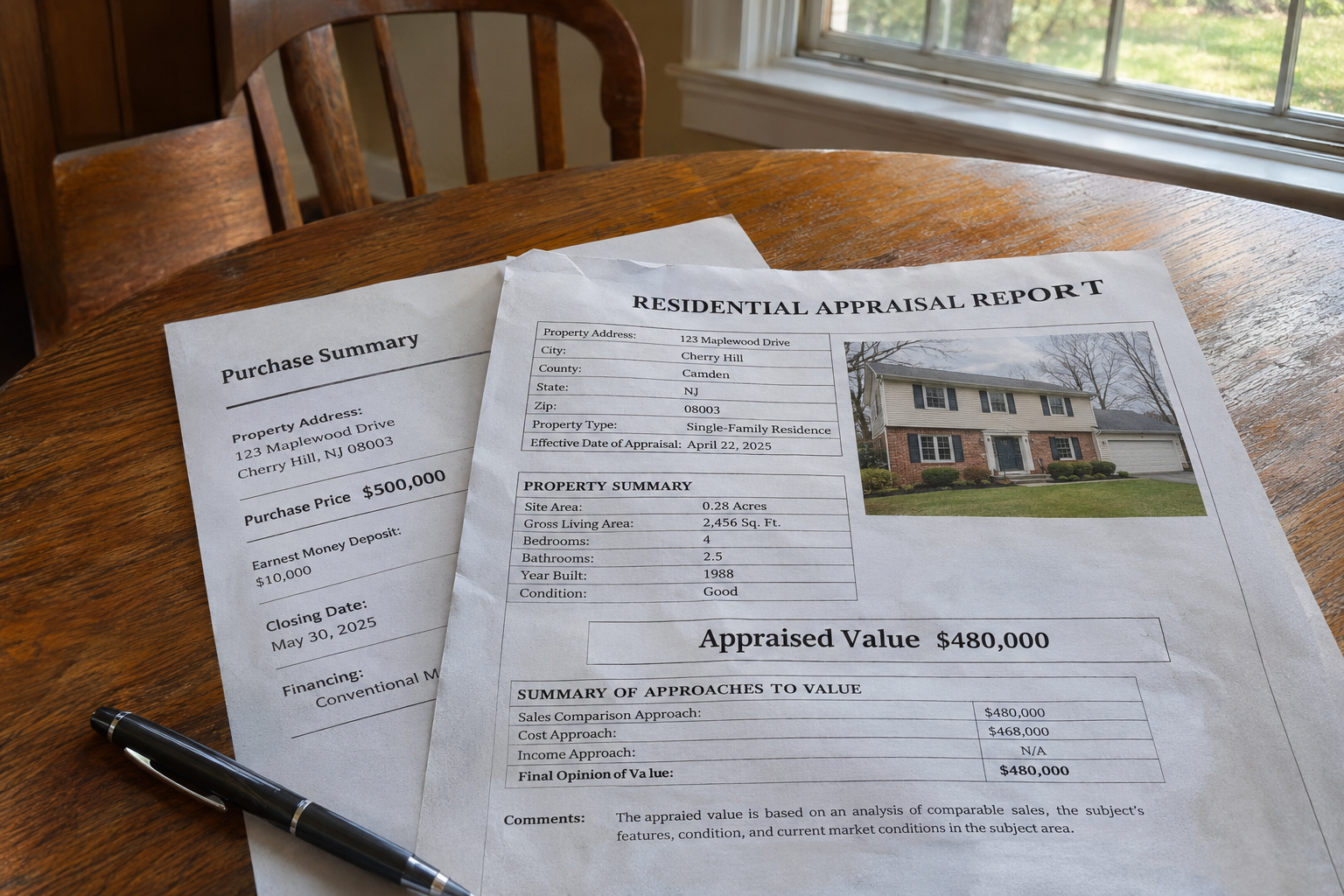
Your $500,000 offer on a home in Marlton was accepted. Then your lender sends you the appraisal, and the home comes in at $480,000. Do you need to find another $20,000 to close?
You have a few options. You can ask the seller to lower the price, bring more cash, or cancel if your contract gives you that right. Your next step depends on your financing, your contract, and how much you’re comfortable spending.
Here’s how a low appraisal can affect a home purchase in New Jersey and what you can do to keep the transaction moving.
What Is an Appraisal Gap?
An appraisal is a professional opinion of a home’s market value. Appraisers consider the property’s condition, size, features, and comparable home sales in the area.
An appraisal gap is the difference between the agreed purchase price and the home’s appraised value. If you agree to pay $500,000 and the appraisal comes in at $480,000, the appraisal gap is $20,000.
For many conventional mortgages, lenders calculate the loan-to-value ratio using the lower of the purchase price or appraised value. A lower appraisal can therefore affect how much you can borrow and how much cash you need to complete the purchase.
Does a $20,000 Appraisal Gap Mean You Need $20,000 More?
The amount of additional cash you need depends on your loan structure.
Suppose you originally planned to purchase the $500,000 home with 20% down. Your expected down payment would be $100,000, and your mortgage would be $400,000.
If the home appraises at $480,000 and your lender maintains an 80% loan-to-value ratio, the loan amount would drop to $384,000.
To purchase the home at the original $500,000 price, you would need to contribute $116,000 toward the purchase, plus closing costs. That’s $16,000 more than you originally planned.
This example assumes you keep the same loan-to-value ratio. Your lender can explain whether other financing options are available and how they would affect your payment and cash needed at closing.
Option 1. Ask the Seller to Lower the Price
Your agent can share the appraisal with the seller’s agent and ask the seller to reduce the purchase price.
In our example, you could request a reduction from $500,000 to $480,000. If the seller agrees and your mortgage is $384,000, you would contribute $96,000 toward the purchase before closing costs.
The seller may also offer a smaller reduction. For example, you could agree on a new price of $490,000. With the same $384,000 mortgage, your contribution would be $106,000 before closing costs, or $6,000 more than your original plan.
A seller’s willingness to negotiate may depend on their timeline, other buyer interest, and the strength of the appraisal’s supporting sales.
Option 2. Bring More Cash to Closing
If the seller holds firm at $500,000 and you still want to move forward, you may be able to cover the difference with additional cash.
Here’s how the numbers compare, assuming a $480,000 appraisal and a $384,000 mortgage in each scenario. Closing costs are additional.
Before agreeing, ask your lender for updated figures showing your loan amount, monthly payment, and total cash needed at closing.
Consider how the extra expense would affect your savings after the purchase. You may also need money for moving, immediate repairs, furniture, and ongoing maintenance.
You can ask your lender whether you qualify for financing at a higher loan-to-value ratio. That could reduce your upfront cash requirement, although it may affect your monthly payment, mortgage insurance, and loan terms.
Option 3. Use Your Appraisal Contingency
An appraisal contingency may allow you to cancel the purchase and recover your deposit if the home appraises below the amount specified in your contract.
For a New Jersey home purchase, your real estate attorney should review the signed contract and any changes made during attorney review. The wording determines your options, deadlines, and notice requirements.
If you agreed to cover an appraisal gap or waived an appraisal contingency, your options may be more limited. An agreement to cover up to $10,000, for example, needs to be evaluated according to the actual contract language.
Contact your attorney promptly after receiving a low appraisal so you can act within any applicable deadlines.
Can You Challenge a Low Appraisal?
If you believe the appraisal contains errors or overlooks relevant information, ask your lender about a reconsideration of value.
Your agent may be able to help identify issues such as incorrect square footage, inaccurate property details, or comparable sales that deserve consideration.
The request goes through the lender’s review process. Providing additional information can lead to a review, although an increased value is never guaranteed.
While that review is underway, your attorney can help you address any approaching contract deadlines.
Frequently Asked Questions About Low Appraisals in NJ
Does the Seller Have to Lower the Price After a Low Appraisal?
A low appraisal gives the buyer a reason to reopen negotiations. The seller can agree to reduce the price, propose a compromise, or hold firm. Your contract and financing determine what options you have next.
Can I Lose My Deposit If I Walk Away?
Your ability to recover your deposit depends on the contract, applicable contingencies, and whether you follow the required procedures and deadlines. Have your New Jersey real estate attorney review those terms before deciding to cancel.
Is Appraisal Gap Coverage the Same as a Larger Down Payment?
Appraisal gap coverage is a contractual commitment to pay above the appraised value under specified terms. Your down payment is the portion of the purchase you fund yourself. Both affect how much cash you may need, so your lender and attorney should review how they work together in your offer.
Can a Low Appraisal Delay Closing?
A low appraisal can delay closing if the buyer and seller need time to renegotiate, the lender must revise the financing, or an appraisal review is requested. Your agent, lender, and attorney can coordinate the next steps and determine whether an extension is needed.
Buying or Selling a Home in South Jersey?
An appraisal can affect the financing and negotiations on either side of a transaction. At Zielinski Real Estate Group, we help buyers and sellers review comparable sales, understand their options, and work through negotiations alongside their lender and attorney.
Whether you’re preparing an offer or navigating a low appraisal on a home already under contract, we’re here to help you figure out your next step.
Contact Scott Zielinski today:
📲 Call or text 856-264-8671
📧 Scott@zhomesrealestate.com
🌐 zhomesrealestate.com
Categories
Recent Posts









REALTOR® License ID: NJ - 1645364 | PA - RS339644
+1(856) 264-8671 | scott@zhomesrealestate.com